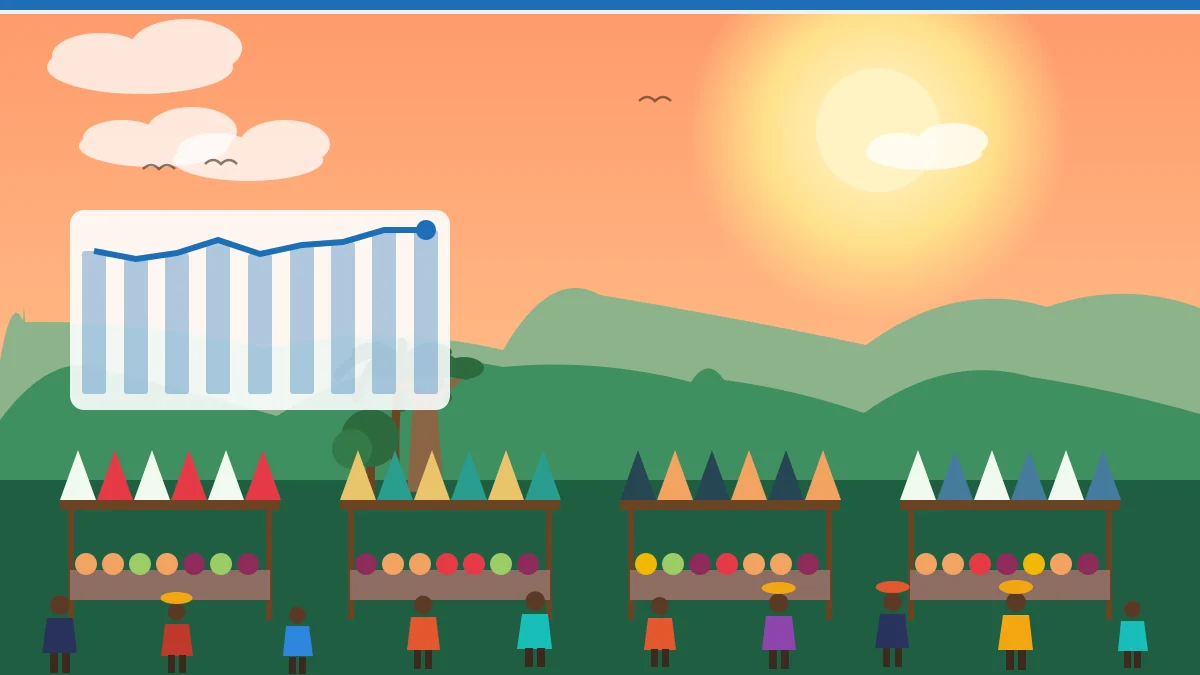
Sierra Leone has more people of working age than ever, and a smaller share of them are in the labour market. The World Bank's 2025 Sierra Leone Economic Update found that labour-force participation fell from 66% in 2001 to 53% in 2022. Over 2001 to 2021, the working-age population grew 3.4% a year.
That combination affects household incomes, consumer demand and the economy's growth potential.
More People, Lower Participation
The ground is a population expanding quickly. A working-age population growing at 3.4% a year doubles in roughly two decades. Sierra Leone's economy has had to absorb that growth after the civil war, the Ebola epidemic of 2014 to 2016, the commodity price collapse and the pandemic.
At the same time, the share of working-age people who are working or actively seeking work fell by 13 percentage points. More people are outside the labour force altogether.
Why Participation Fell
The mechanism has several parts, and not all of them are negative. More young people are staying in school longer, which lowers participation now but raises skills later.
Other reasons are more troubling. Where jobs are scarce, some people stop looking, especially young people in towns who see little point in searching for formal work that does not exist. Some move into unpaid household or family work that may not be counted. Women's participation can fall when farming declines and there are few alternatives nearby.
The economy's structure contributes. Growth led by capital-intensive mining creates few jobs, so the demand for labour does not keep pace with the supply of people.
What It Means for Business
The consequence for consumer businesses is that household incomes are stretched. With fewer earners supporting more dependants, spending per person stays low. Families depend on a small number of earners, remittances and informal income. Products must be affordable, sold in small quantities and widely distributed.
For employers, the pool of available labour is large, but many potential workers lack skills or experience. Firms that recruit and train young people can build reliable workforces.
There are commercial opportunities in bringing people into work. Vocational training, apprenticeships, digital platforms that connect workers with jobs, and businesses that create flexible work for women and young people can grow in this market.
Over the long term, higher participation would add earners to households and raise demand across the economy.
Women and Participation
Participation trends differ between men and women. In many economies like Sierra Leone's, women's participation is shaped by farming, family responsibilities, access to education and the availability of work near home. When farming declines or becomes less profitable, women who worked on family farms may leave the labour force rather than move to wage work elsewhere.
Women also carry most of the unpaid work of caring for children and relatives, fetching water and fuel, and preparing food. Where these tasks take many hours, women have less time for paid work. Access to childcare, water and energy can free time for income-earning activities.
Raising women's participation is one of the most direct ways to add earners to households and raise incomes. Programmes that support women's businesses, provide training and finance, and reduce the burden of unpaid work can have large effects.
What Firms Can Do
For employers, low participation means potential workers are available but may need encouragement and support to join the labour force. Offering flexible hours, safe transport, training for people without prior experience and clear pathways to permanent jobs can attract workers who have stopped looking.
Businesses that operate close to where people live, such as processing plants in farming areas, can draw on local labour that would not travel to distant towns. Digital and platform-based work can reach people who need flexible arrangements.
For consumer businesses, rising participation would add income to households over time, increasing demand. For investors, sectors that bring people into work, including agro-processing, light manufacturing, services and skills training, align with the country's most pressing economic need and are likely to attract policy support.
The participation decline also affects tax revenue and public finances. Fewer people in formal work means fewer people paying income tax and social contributions, narrowing the base on which the state can draw. Raising participation, especially in formal jobs, would strengthen public finances over time and give the government more room to invest in the services that help people into work. Each additional worker brought into the labour force adds to household income and to the market every business serves.
Bring People Into Work
The decisive point is that Sierra Leone's growing population is not yet a growing workforce. Businesses should invest in training and recruitment of young people, and consumer companies should price for households with few earners.
Investors should look at skills, labour-intensive industries and platforms that connect people with work. Raising participation is one of the most direct ways to raise household incomes in Sierra Leone.