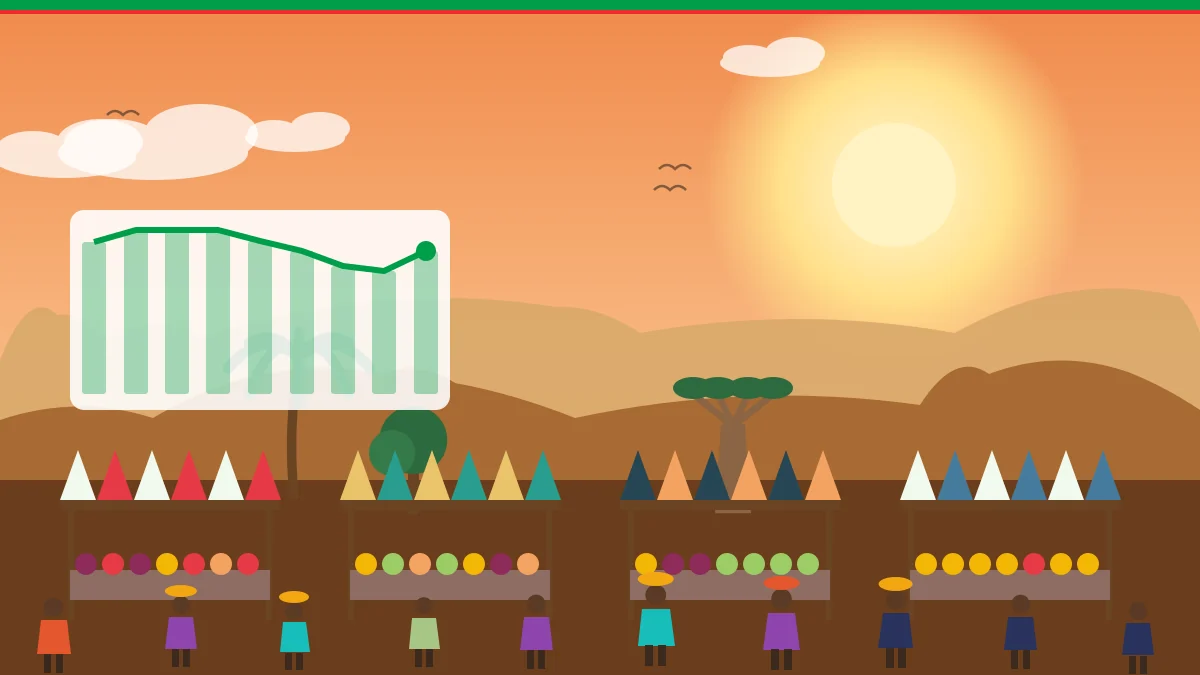
Burkina Faso's economy has grown a great deal, and its people have not gained nearly as much. The World Bank's 2024 Country Economic Memorandum found that real output had tripled over two decades. Yet GDP per capita had not doubled, and the number of poor people had barely changed.
That gap between national growth and household welfare is the central economic problem the memorandum sets out to explain.
Growth That Did Not Reach People
The ground is two decades of steady expansion. Burkina Faso grew at solid rates for much of the period, driven by gold, cotton, farming and services. The economy that emerged is far larger than the one of the early 2000s.
But the population grew fast too, at close to 3% a year. Output divided among many more people rose much less per person. And the growth was concentrated in sectors, especially industrial gold mining, that employ few people and spread little income to households. The poverty rate fell somewhat, but with a fast-growing population, the number of poor people stayed roughly the same.
Why Growth Missed the Poor
The mechanism the memorandum points to is how growth happened. Most of it came from adding more labour and capital, not from using them more productively. Farming, which employs most Burkinabè, remained largely low-input and rain-dependent, so the incomes of most workers rose slowly. People who moved out of farming mostly went into informal services with similarly low productivity, not into higher-paying jobs.
Gold, the fastest-growing sector, is capital-intensive. It produces large export earnings and public revenue but relatively few jobs and limited links to local suppliers. Its gains reach households mainly through public spending, which insecurity has increasingly pulled toward defence.
Climate shocks and insecurity have added to the problem, repeatedly destroying assets and disrupting livelihoods in rural areas.
What It Means for Business
The consequence is a large but low-income consumer market. Burkina Faso's economy is big in aggregate, but most households have little to spend beyond essentials. Consumer businesses must design for low incomes, small purchases and rural as well as urban buyers.
It also identifies where growth could become more inclusive, and therefore where business can grow with it. Raising farm productivity through better seed, fertilizer, irrigation, mechanisation and market access lifts the incomes of the majority. Processing cotton, shea, sesame, cashew and livestock products at home creates jobs and adds value. Expanding reliable electricity and finance lets small firms grow.
The Population Factor
Burkina Faso's population has grown at close to 3% a year, one of the fastest rates in the world. That means the economy must grow at least 3% a year just to keep income per person constant. Growth of 5% or 6% translates into only 2% or 3% growth per person.
Rapid population growth also means a large and growing number of young people entering the labour market each year, and growing demand for schools, health services, housing and jobs. Meeting those needs requires large public and private investment.
Over time, as education spreads, especially for girls, and as health services improve, fertility rates tend to fall. That demographic transition, if it comes, can open a window in which the working-age share of the population rises, boosting growth per person.
Making Growth More Productive
The Country Economic Memorandum points to several ways to make growth more efficient and inclusive. Raising agricultural productivity is the most important, because most Burkinabè work in farming. Better seed, fertilizer, irrigation and market access can increase output and incomes.
Developing agro-processing and manufacturing would create more productive jobs outside farming. Burkina Faso has raw materials such as cotton, shea, sesame, cashew and livestock that could be processed at home.
Improving infrastructure, especially electricity and roads, would lower costs for all businesses. Investing in education and skills would raise the productivity of the workforce.
Security is a precondition. Without stability, investment in rural areas is difficult, and the gains from growth are lost to displacement and disruption. For businesses and investors, the memorandum's agenda points to sectors where growth can reach more people, and where returns may be supported by public policy and development finance.
The memorandum also points to the cost of climate change. Droughts, floods and rising temperatures have repeatedly destroyed crops and livestock, setting back household incomes. Investments in climate resilience, including water management, drought-tolerant crops and early warning systems, are essential to protect future growth and make it more inclusive.
Back the Productivity Agenda
The decisive point is that Burkina Faso's next phase of growth must come from productivity, not just from more inputs. Investors should look at agribusiness, agro-processing, energy and finance for small firms, the sectors that raise incomes for the many.
Consumer companies should plan for a market that grows in numbers faster than in spending power. If the economy triples again in the next two decades, the question is whether household incomes do too.